The Drama Review: Do we need to know everything about our partners?
Table of Contents
“What’s the worst thing you’ve ever done?”
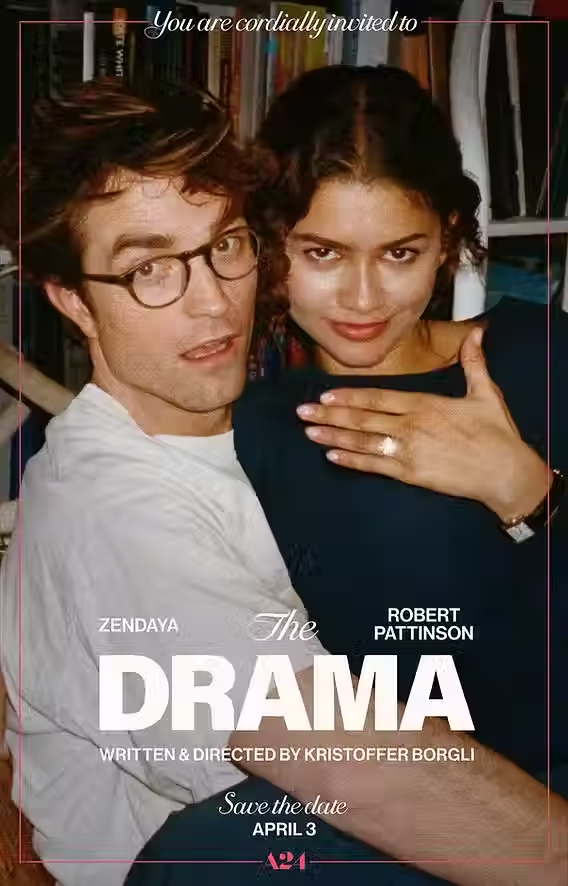
The drama (2026) is labelled as a romantic (dark) comedy, and many people laughed in my screening. But the truth is.
I found this film to be quite sad.
The main question the film poses is:
How far does our love go if and when we discover the darkest parts of each other? People say love is unconditional, but I think love always comes with unsaid conditions, and these characters definitely represent that or question that themselves.
The trailer centres around what Emma did that changed Charlie's perspective of her.
Emma (Zendaya) and Charlie (Robert Patterson) are having some kind of rehearsal dinner with their two ‘closest’ friends, Mike and Rachel. They then decide that it’s a great idea to share the worst thing they have ever done. This conversation was prompted by Rachel, which is important to highlight. *Spoilers from here on out*
The Reveal

Mike, Rachel's husband and Charlie's best friend, was very resistant to opening up this can of worms again. As they had both promised each other not to bring it up. If you didn't catch the direction, this is going in Rachel is not a nice person. She represents the theme of performative outrage and hypocrisy. Before this dialogue even began she never liked Emma, constantly throwing sharp jabs and expressing her not so secret, secret animosity towards her. Rachel's character thrives off moral showboating and social control, which is why she brought this topic up against her partner's wishes to begin with.
Mike goes first, saying how on his ex-girlfriend's birthday, a wild dog came out and started attacking them. He didn't help his girlfriend at the time, stressing the fact that things had been going poorly between them anyway. So he essentially used his ex’s body as a shield while the wild dog bit and scratched at her.
Then it's Rachel's turn, she reveals that when she was younger, she followed this little neighbourhood boy who had learning disabilities to this abandoned shed. She describes it as being covered in porn magazines and empty beer cans. She says she had an impulse to then lock the child in a closet, ignoring his screams. She was very flippant while retelling the story, making up excuses for forever traumatising that little boy. Even laughing at the fact that there was a search party and they only found him the next day. She even walked past the boy's father and lied and said that she never saw him!
Putting it bluntly, that's some next-level devil shit.

Charlie, weirdly enough, found it all funny, partly because he was drunk and, in all honesty, a bit of a wimp. Emma looked uncomfortable, especially as she kept asking about the safety of the boy and what happened to him.
Charlie revealed that he had cyberbullied someone so terribly that the kid and his family had to move. This was all laughed off by Mike and Rachel, Mike saying that Charlie was fourteen, so it was fine, his frontal lobe hadn't developed.
Last but certainly not least, Emma told everyone that when she was a teen, she had planned to carry out a school shooting.
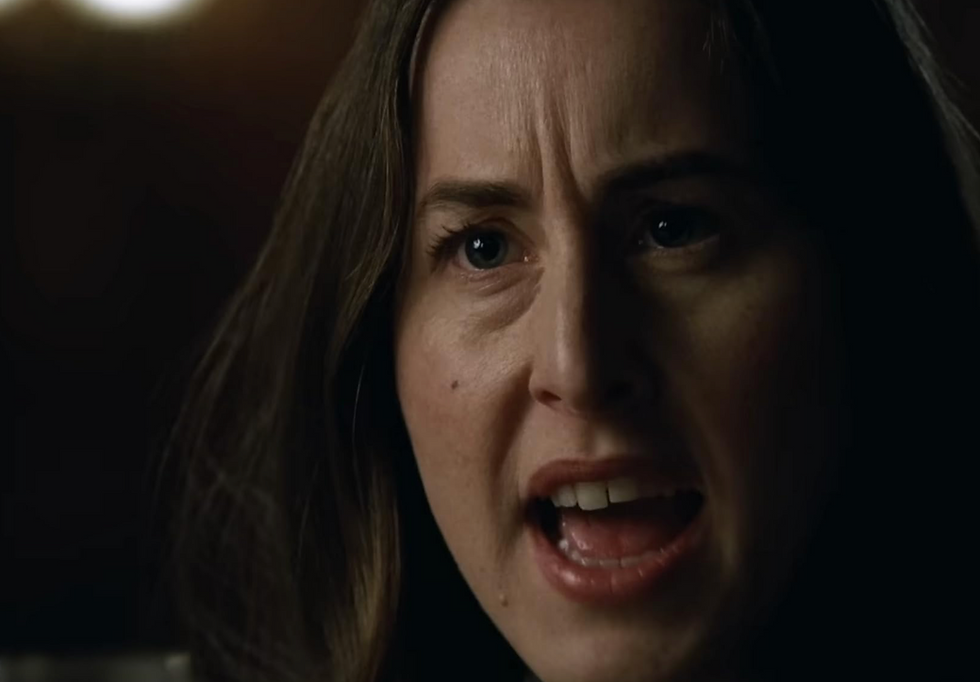
Rachel, being the moral purist and alarmist she is, started screeching her head off, stating how her cousin is in a Wheelchair because of a school shooter. Types like Rachel will always make sure they're in positions where they can use people around, especially minorities, as their personal shields. Taking their experiences and using them for their own moral grandstanding. Later in the film, when Charlie is in full meltdown mode, half of him is trying to empathise with Emma, the other half is battling with his new vision of her. He runs into Rachel's cousin, and he ends up making things painfully awkward, trying to apologise for something that Emma didn't follow through with, something that the cousin likely wasn't aware of. In the end, he was the one who made Rachel's cousin uncomfortable, and this is going to be important later on.
This is important to note: it reminds me of the times in school where people were afraid of describing someone as black or brown (someone's actual race), but completely ignored actual racism because that's the hard part. Accountability.
All the things that Rachel, Mike and Charlie did are what led to people committing acts like what Emma almost did.
The Impact of Bullying &
Glamorisation of Violence
I wanted to make it clear that my being in defence of Emma as a character is not me excusing the real harm of mass shootings and the devastation that they cause. Something that I always carry with me is that trauma is an explanation, not an excuse. This film forces us to move away from black and white thinking and to be as nuanced as possible. Nuanced thinking is not common these days, perhaps it never really was. But it is especially lacking in this political climate, on all sides.
Charlie kept digging into what and why his fiancée would almost do such a thing. Treating her like a convict in their shared home. Emma did, however, open up. She shared her experiences about being bullied. To no one's surprise, Charlie the ex-cyberbully simply responded to her experince by saying.
"Is that it?
Bullying, especially in your teens, shapes you. It varies from person to person, but that feeling of isolation, fear, and hatred for yourself, and resentment towards others, really eats you alive and can lead you down vulnerable and dangerous paths. This pain and inner turmoil often lead to people expressing it externally.
It's easy for the Charlies of the world to laugh off bullying. While still being able to claim moral purity whenever it suits them. One of the biggest lessons of the world is that monsters are the ones who don't look like monsters, the ones who are the loudest about morals and kindest usually end up being the cruellest.
The film touches on how pain and violence are glamorised.
Emma talks about how in online subcultures being a female shooter was seen as rare, edgy and cool. Many online forums, ones that aren't even on the dark web, such as Reddit and Discord, end up being hubs and cesspits of misery. It’s those who are going through the same thing and worse, collectively communicating with each other.
If pain can be made into an aesthetic, it can be made into something that vulnerable people can buy into. Pain is made into a commodity, an identity to reclaim and incorrectly heal the damage that has been done. The commodity (goods/product) in Emma's case was guns; this persona she could slip into. Another example of this is how self-harm can be used as an aesthetic.

But Emma did something that all of the other characters never did. She evolved.
She faced her demons, she repented not only with words but with actions. That's why she has more empathy for human beings and animals than the friends who criminalised her. That's why she cries when she sees a squirrel; that's why she wasn't judging the DJ for (possibly) being on drugs. Emma was only hard on the DJ because she wanted to assimlate and seem 'normal'.
Charlie was the problem.

Charlie, the quintessential, awkward yet charming British guy.
Yeah, he f*cked up.
If you want a guide to how to ruin your perfectly fine relationship, wedding, life and reputation, then watch this film and take notes. Recently, I have been consuming media which challenges the innocence of the awkward nice guy archetype and shows how dangerous they actually are. Wolves in sheep's clothing. From the first scene with him, we realise he is honestly a little weird.
He sees Emma reading her book, he finds her attractive and decides to lie and say that he has read that book, but she couldn't hear him as she is deaf in her right ear. When she isn't responding, we see from his perspective that he interprets everyone watching him. This was a big tell about his character and the demise of his credibility.

Throughout the rest of the film, he made everyone uncomfortable. Slipping from one delusion to another. He opens up to his co-worker (Misha), creating a hypothetical situation in which he mentions having a partner who was going to commit a school shooting.
Misha states that what if there wasn't that coincidence that stopped them from going ahead with the shooting? and continues by saying that they are essentially the same person. Charlie crashes out at this point, and in the same conversation, Misha reveals how she had cheated on her ex-boyfriend, but she's changed now. You see the contradiction?
Anywho, her loyalty didn't last long. As Charlie kisses Misha, she kisses back and pitifully turns her backside over without a second thought. This again reinforces the theme of hypocrisy and moral superiority.
Charlie was ruined by shame.
All he had to do was sit and stay calm and listen to Emma. Of course, finding out a secret like that would shock anyone. But he handled it horribly. He criminalised her and effectively himself. He was so riddled by shame, worried about what others would think about Emma's secret, that he ended up exposing himself and his own sins. He ruined his perfect wedding speech, disgusting Emma's family and confusing his parents.
He was so worried that Emma would ruin the wedding, but it was he, he, who ruined it. Misha's boyfriend finds out that Charlie kissed his girlfriend, thanks to Charlie saying it out loud in front of everyone. Misha's boyfriend headbutts Charlie, and a brawl takes place. We, the audience, discover this through sharp flashbacks as Charlie makes it back home.
At the end of the day, Charlie was labelled publicly as a workplace sex pest and harasser. He was the one who ended up being seen as the monster in everyone's eyes, and making a fool of himself. It was a manifestation of a self-fulfilling prophecy.
So do we need to tell our partners everything?
No.
Knowing everything about someone doesn't mean we know them. We know facts about them, but not who they are. Of course, there are certain things that you are obligated to tell your partner. Unfortunately, opening up doesn't guarantee empathy and understanding, even from those who we hold near and dear to our hearts.
There is a scene where Emma tries to restart again with Charlie, pretending that they had just met. But Charlie refused to play along, behaving as if Emma were a leper. In the last scene, the tables turned slightly. Emma is the one who offers her hand to Charlie, for her to forgive him and start as strangers.
I have mixed feelings on whether or not the scene was imagined in Charlie's mind or not. But it says a lot about the difference in character.
I do think that true love is being able to forgive one another, to see our worst sides and hopefully be able to grow together from it and for that love to be there but stronger. But even then, that statement comes with several different layers.
Well, I hope you enjoyed this review. Share this, save it and most importantly, subscribe.
By the blog editor, theconsciousthoughts.


Comments